At CAPACOA, we constantly strive to bring international opportunities to presenters and artists by participating in international engagements and building meaningful connections across the globe.
We’re excited to expand our Notes From the Road series beyond our All Access newsletter and onto our website as a blog series, as well as across our social media channels (Facebook and Instagram). Through the eyes of CAPACOA delegates, Notes From the Road shares firsthand perspectives on international performing arts opportunities, events, showcases, and cultural exchanges that strengthen Canada’s performing arts sector. Each edition features a delegate’s reflections on their experience, along with a spotlight on an artist whose work left a lasting impression.
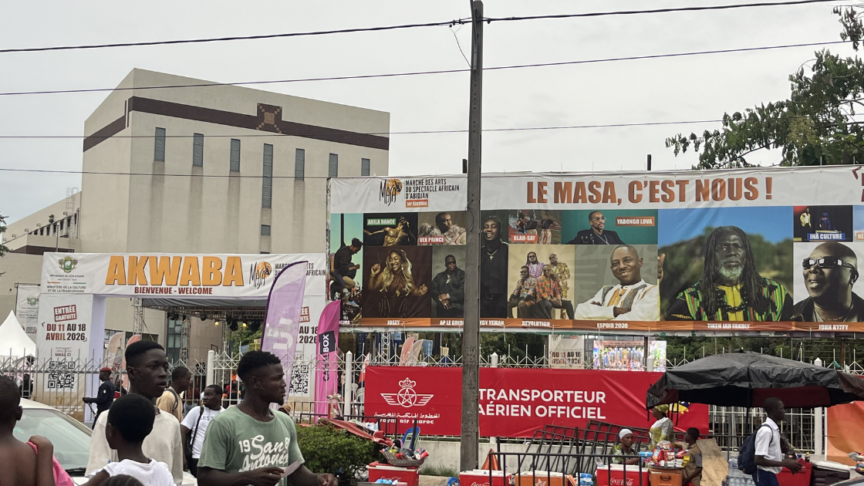
In this edition of Notes From the Road, Liliona Quarmyne, Artistic Director of Live Art Dance, reflects on her experience at the Abidjan African Arts and Performance Market (MASA) and highlights the work of Gregory Maqoma, Vincent Mantsoe, and Mai-Juli Machado.
Liliona’s Reflection
When my friend and colleague, Raeesa Lalani, was part of the CAPACOA delegation to Le Marché des Arts du Spectacle Africain d’Abidjan (MASA) two years ago, she came back to Kjipuktuk/Halifax with a clear directive: “Liliona, you HAVE to go.” I’d heard about MASA over the years, and Raeesa’s enthusiasm put it strongly on my radar. So, when the opportunity to attend with CAPACOA came up earlier this year, I jumped at the chance. I’m certainly glad I did, because what an incredible trip it was! Pretty wild, but incredible.
Our delegation – Gabrielle Martin, Alfredo Caxaj-Ruiz, myself, and fearless leader Judy Harquail – spent eight days in Abidjan, and if I were to detail everything we experienced you’d be reading for a looong time. So, I’ll just share a couple of the things I’m thinking about as I reflect.
Contemporary Dance is Alive
It’s been a long time since I’ve seen the kind of raw energy that came from MASA audiences. So often I hear narratives around how contemporary dance is dying and how inaccessible it is to audiences, but that’s not what I experienced in Abidjan. What I experienced was audiences roaring to their feet to cheer, jump up and down, dance, and holler wildly with appreciation for what they’d experienced. It was an exhilarating and wonderful reminder that, despite what it may sometimes feel like, contemporary dance is very much alive.
Colonialism’s Complicated Legacies
Côte d’Ivoire neighbours Ghana, which is one of the countries I’m from (the other being the Philippines). With dance artists traveling from across the African continent to share work at MASA, I was looking forward to meeting new-to-me dance artists from Ghana. But that didn’t happen – I didn’t meet a single Ghanaian dancer or choreographer. In fact, there were very few artists from Anglophone Africa present at all. I know language is part of the reason for this, but it’s also the way colonial legacies have played out. France invested heavily in the arts both during and post colonization, while the British focused on economic gains and extraction…and that’s what I saw on display at MASA. Please don’t get me wrong here – to my mind, no version of colonialism is to be valued over another, and I’m certainly not saying that French colonization was ‘better’ than British. But, as far as dance goes, Anglophone and Francophone Africa are in very different places. It’s complicated.
Craft at the Centre
By Canadian presentation standards, the conditions the artists were dealing with were pretty terrible. Hardly any tech support; squeezing huge pieces onto tiny stages; dancing outside in the blazing heat on concrete – the list goes on. Despite all that, the work really shone through. Of course, some pieces spoke to me more than others, but I was glad I was in the room for every piece that I saw (and I saw a lot of them). The commitment to the craft stood out so strongly, and the conditions couldn’t diminish that.
Artist Highlight
Gregory Maqoma, Vincent Mantsoe, and Mai-Juli Machado
We saw a great double bill by Gregory Maqoma & Vincent Mantsoe that we’re working to bring to Canada in 2028. There are several other artists whom I find interesting, but the other one I’ll mention for now is Mai-Juli Machado. Mai-Juli is a young Mozambican choreographer and dancer who is entering a new stage in her career; I found her solo that “traces a generational journey of women, marked by memories, experiences, and transformations” beautifully nuanced.
Liliona Quarmyne, Artistic Director, Live Art Dance