Why understanding the rules is the first step to changing them
Ticket resale has become one of the most persistent and frustrating challenges in the live performance sector. Audiences dislike it. Presenters lose revenue and trust. Across Canada, the rules governing ticket resale are fragmented, inconsistently enforced, and often poorly understood.
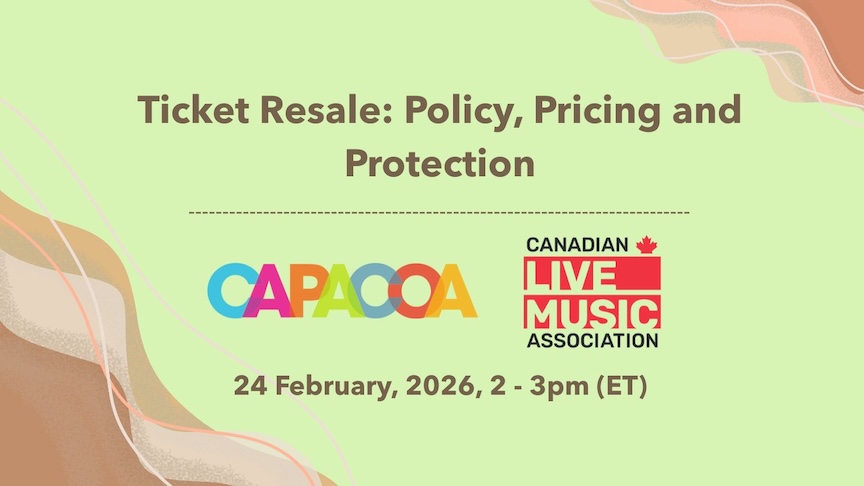
This blog post accompanies the upcoming “Ticket Resale: Policy, Pricing and Protection” Town Hall taking place on February 24, 2026, from 2-3 pm EST. Presented by CAPACOA and the CLMA, the event is part of an ongoing series exploring practical and policy-driven strategies to combat ticket resale.
To learn more about types of ticket resale and fraud and how different presenters have dealt with them, watch our first town hall, “Fighting Resale and Ticket Fraud: Strategies for the Live Performance Sector.” To learn about data-driven solutions, watch the follow-up “Outranking Resale Sites: Strategies That Work.”
Why this conversation matters
Ticket resale is often framed by ticketing platforms as an inevitable by-product of demand. In practice, it is a structural issue shaped by uneven regulation, limited enforcement, and increasingly sophisticated resale websites. For arts organizations, this translates into missed earnings opportunities, confusion about compliance obligations, and growing frustration from audiences who feel misled about pricing and availability.
While there is no single solution, understanding the legal and policy landscape is a necessary starting point. Without it, organizations are left reacting to resale individually rather than addressing it strategically.
What federal law says about pricing
At the national level, drip pricing (the practice of advertising a base price and revealing mandatory fees only at checkout) is illegal under Canada’s Competition Act. As of June 2024, amendments introduced through Bill C‑59 make it clear that the only fees that can be excluded upfront are government-imposed ones, such as sales taxes. All other charges must be clearly disclosed at the outset, or sellers may face enforcement for misleading representation.
These rules apply to both traditional advertising and digital listings, including offers embedded in structured data. The Canadian Code of Advertising Standards reinforces this by requiring that all pertinent details be clearly stated, and that omissions must not mislead the consumer. Despite this clarity at the federal level, enforcement is uneven and interpretation still varies from province to province, especially when it comes to what counts as “total price.”
A patchwork of provincial rules
More specific ticket resale laws in Canada vary significantly from province to province. Some jurisdictions have ticket-specific legislation; others rely on general consumer protection frameworks; some have recently rolled back resale restrictions altogether.
Here is a high-level snapshot of the current landscape:
Ontario
Ontario’s Ticket Sales Act requires disclosure of the total ticket price, including fees, and places conditions on resale above face value. However, enforcement remains limited, and resale activity continues to flourish.
Quebec
Quebec has the most restrictive resale framework in Canada, prohibiting resale above the price authorized by the producer, with limited exceptions. Prices must include mandatory service and delivery fees upfront, though taxes may be excluded.
British Columbia
British Columbia requires disclosure of total ticket prices and itemized fees, but like other provinces, faces challenges related to enforcement and cross-border resale platforms.
Saskatchewan
Saskatchewan does not have ticket-specific resale legislation. Ticketing practices fall under general consumer protection law. This inconsistent patchwork leaves both presenters and audiences vulnerable, and creates openings for exploitative practices.
Manitoba
Manitoba repealed its ticket resale legislation in 2023. Ticket resale is now governed only by general consumer protection rules, with no resale price caps or ticket-specific obligations.
For a real-life example of the effects of ticket resale and a high-level snapshot of the current ticket resale landscape, click here
The limits of legislation alone
Across provinces, several common limitations emerge: laws often lack clear enforcement mechanisms, jurisdictional differences are exploited by online resale platforms, and responsibility for compliance is frequently shifted onto presenters without meaningful tools to intervene.
This raises an important question for the sector: If regulation alone isn’t enough, what else is required?
What this town hall will explore
The Ticket Resale: Policy, Pricing and Protection Town Hall tackles ticket resale as a structural issue shaped by public perception, uneven regulation, and weak enforcement. Building on earlier sessions in the series, this conversation will go beyond fraud and technical fixes to explore how resale is framed politically, where policy breaks down in practice, and how those breakdowns affect presenters’ bottom lines, artists’ visibility, and audiences’ trust.
Featuring Dan Moulton, a strategist who guides major consumer-facing organizations through reputational and policy challenges, and Jon Weisz, a cultural worker with deep experience in resource sharing and sector dynamics, the session will be a forum for sharp insight and grounded experience. Together, we’ll ask what’s missing, what’s working, and what the sector can do next.
Written by: Morgan Pannunzio and Sam Bean